Your browser is not supported. Please update it.

Uncategorised

X to opt in – the new rules for GDPR…

Over the past few months GDPR (General Data Protection Regulation) has been a hot topic for golf courses.

We are by no means experts in the field, however we have been diligently undertaking research to make sure we are in the know. This checklist is a great starting point and will really help a golf course to understand the implications of GDPR. You can also find out more information about GDPR from the ICO who are the authority on the use of data via this website.

It is important to have an awareness of the data that you can and can’t use when the new legislation comes into force on 25th May 2018. The key is to understand how you have obtained the data in the first place. If you have a booking system that logs the email of your customers when they book, this is referred to as a ‘soft opt in’. As long as that customer is given the option to unsubscribe to all follow up communications you send them, you can continue to market to them under the new rules without having to get them to opt in again.

On the other hand, if the customer information has been obtained through a data gathering competition entry, bought from a third party or come into your possession by some other means, the individual needs to have actively chosen to opt in to receiving your communications at some point. Unless this has been done, you will need to get them to opt in or you are no longer able to use their data.

There are significant fines for the misuse of data so if you are in any doubt about the new rules, the ICO website is the best place to start.

Read more

Rob Corcoran joins The Revenue Club

Former Royal Navy officer, Rob Corcoran has joined The Revenue Club, a specialist revenue management service which helps golf courses to realise the potential of operating effectively online. After leaving the Royal Navy, Rob was instrumental in growing Teeofftimes.co.uk, the market leaders in online green fee sales, from an early stage through to their subsequent acquisition by GolfNow and NBC Universal.

As an Account Director at Teeofftimes.co.uk, Rob had six years’ experience working alongside golf clubs and helping them to generate growth in their visitor bookings. “Developing revenue from online sales is a continually evolving area of opportunity for golf clubs and I am very excited about the prospect of working closely alongside our partners to help them achieve this.” Said Rob who is based in the West Midlands. “The fundamental services offered by The Revenue Club have already been proven to deliver significant gains in a short space of time, and by understanding the needs of golf clubs and the digital market place we are able to combine the two areas to deliver a unique service.”

Co-Director of The Revenue Club, Chris Knight said “Rob has an outstanding track record in the industry and a wealth of experience in digital marketing and revenue management. Rob’s skill set and experience will help The Revenue Club continue to serve our course partners to the highest standard. We are delighted to have him joining the team.”

The Revenue Club was founded in 2017 with the mission to offer independent online visitor golf revenue expertise to UK and Irish golf course operators through a monthly subscription. The consultancy creates and delivers effective digital strategies that work in the best interest of the golf course.

Read more about how we help golf course operators to generate more online green fee sales via our blog

Read more

W is for What are your 2018 digital resolutions?

Reflecting on 2017 there was an obvious and continuing shift to more golfers booking online which includes both members and visitors.

In 2018, improving a golf courses’ digital experience, combined with lowering online distribution & technology costs will be key to increasing the bottom line. The good news is that with the right focus, and appropriate investments in digital technology and marketing initiatives, significantly more profitable bookings and a decreased dependency on the third parties can be realised.

It’s important to note that no one is suggesting golf courses throw the baby out with the bathwater. Third parties do provide essential exposure (especially for independent golf courses), and they help fill low demand periods, but they must make up part of a wider digital strategy.

We’ve picked our top 8 digital resolutions to share with you before the start of 2018:

Data:

Virtually every golf course has access to more data than they realise, and they can use this data to promote direct bookings from societies to pay and play green fees.

  • Resolution 1: Gather all of your data and get it into some form of CRM system with relevant tags. i.e. member, visitor, society etc.

  • Resolution 2: make sure you are capturing visitor data at the point of sale and on your website through a data capture form. This can be supported by asking people for their data in return entry into some form of competition. i.e. win a 4 ball.

Supply and Demand:

The utilisation of a golf course varies greatly from hour to hour, day to day, week to week and month to month. The golf course operator therefore has to ensure that their pricing is appropriate to the availability and demand of the golf course, they also have to take into account other factors such as weather and competitors.

  • Resolution 3: Dynamically price the tee sheet.

  • Resolution 4: Make sure you have an understanding of your third party booking costs, and are working to increase total bookings while decreasing their associated costs. A key way to do this is increasing the share of total bookings made direct.

Marketing:

Golf course operators in general are notorious for under-investing in digital technology and marketing and being over-dependent on the third parties.

  • Resolution 5: Prioritise generating direct website bookings. Take your overall marketing budget and then allocate the relevant proportion of it to digital spend, and keep the digital marketing budget fluid and dynamic to accommodate changes in business-needs and new opportunities that become available. Digital advertising versus traditional print advertising is much easier to understand the ROI.

  • Resolution 6: Mobile traffic continued to grow in 2017, make sure your digital marketing is mobile friendly.

  • Resolution 7: Use the data you are collecting from resolution’s 1 & 2 and get marketing to them, whether it be email, social media or SMS.

Website:

With the need to prioritise the direct booking channel coupled with an increasingly complicated path-to-purchase behaviour of the multi-channel and multi-device golfer, today’s golf course website cannot afford to be read as a static brochure. The real long-term cost of operating a poor website is a loss of enquiries for memberships, societies and functions combined with a loss of direct revenue from online green fees, increased distribution costs and increased dependency on the third parties.

  • Resolution 8: make a booking as a member and a visitor on your website along with a general enquiry. Make sure you do this on various devices and from various platforms i.e. from Facebook on mobile through to Google Chrome on desktop. If you have any problems, note them down and then work through fixing them systematically. This may mean changing technology provider or website provider.

Read more

V is for Visitor golf strategies in 2018…

Data will (or at least should ) drive your visitor golf strategy. In order to set a well thought through strategy, a golf course needs to be able to access historical data, and then be able to access this data on the fly to ensure that the strategy is working, and if not change it. When you have access to these things, you can visualise what you need in terms of a distribution/visitor tee time booking strategy and where to focus your attention.

Here are some the things a golf course should know:


  • Website statistics: Are you analysing the web traffic you are getting, what the source is (social media, Google etc), do they reach your visitor booking engine, if so how many of the visits turn into a booking and is it on the first visit? More than just web stats, you must aggregate website bookings with telephone booking. Considering this information, should highlight if running a digital advertising campaign would help drive more visitors (remember you can run a ‘call extension’ digital advertising campaign which will help drive telephone direct bookings). If you are already doing digital advertising, what are the campaign costs, call coverage costs, and so forth that factor into direct customer acquisition costs.

  • Third Party revenue/commissions/barter: I’m still surprised by how few golf courses understand exactly how much their third party business costs and what the impact of those commissions/barter times is on the bottom line. Since we know third parties are valuable for both exposure and for bookings, only when you know this can you determine what percentage to attempt to shift to the direct booking channel.

  • Pricing strategies: Revenue management is fluid and therefore ever changing. Understanding if you’re hitting utilisation goals too quickly can help you adjust rates up. Conversely, if you’re not reaching your occupancy goals, you need to look at rates, the market/competition, and your reviews—all at one time, ideally. Once you have done this you can question if more revenue should be coming from societies/longer lead bookings or is there more opportunity to sell more online (generally speaking online is where golf courses miss a trick). You of course have to consider how these strategies will impact all users of the golf course including (and in alot of cases most importantly) members.

  • The path to purchase: The vast percentage of website traffic disappears. They probably aren’t booking in one session and they are likely visiting a third party in between. How can you become more attractive without discounting too deeply on loyalty? Speaking of which… if you’re using loyalty schemes (e.g. Flexible membership or loyalty cards) to drive direct bookings, what is the effect on profits? If you are not, are you missing a trick? Also there is generally a quick win of making visitor booking engines easier to find across your digital platforms.

So once you have done this analysis you need to turn it into a series of actions:

Your visitor golf strategy is a living, breathing creature. So often golf courses look at the analytics, take note of some trends (normally provided by a third party so not taking into account the direct bookings), and then set their strategy accordingly. There is no doubt that online bookings are growing, and channel/digital optimisation is not a ‘set it and forget it’ proposition. Golf courses must consistently monitor and evaluate their visitor strategy, then take specific action to increase or better convert traffic. And, yet, what golf course has the resources to avoid a set-and-forget attitude? Very few, indeed.

This lack of resource is exactly why we started The Revenue Club. Our service allows golf courses to outsource the arduous tasks of analysing, revenue managing and marketing the golf course to visitors to us for a monthly subscription.

We will look at various statistics twice weekly, for example when utilisation gets too low, when REVPATT reaches a certain point, poor pickup, high revenue, and so forth. We also co-ordinate any price changes with outbound digital marketing activity such as email, Google Adwords or Social Media posts/advertising in order to maximise their impact. Pair this with tracking third party commissions and your direct web traffic, gives the golf course a much better grasp on where the visitor strategy currently is, and where the opportunity lies.

If connecting the dots between the analysis to action seems like a task your golf course does not have time for, then please get in touch and we would be happy to run a 1 month free trial with you!

#Visitors #Strategy

Read more

U is for Utilisation…

This week we wanted to discuss utilisation and how it can influence green fee price. Historically, golf courses have used a weekday and weekend price, and then more recently ‘early bird’, ‘morning’, ‘afternoon’ and ‘twilight’ pricing has become popular.

The idea behind this pricing strategy was to help drive demand to where the course was quiet, however some courses went down this pricing route in order to compete in the local market, rather than taking into consideration when their golf course was utilised. Pricing based on competition is just one factor to consider when creating a pricing strategy, much like utilisation is a factor (albeit an important one to consider). The key to any pricing strategy is finding the right price, for the right person, at the right time.


This sounds like a simple premise, but this goal needs to take into account three critical elements: the price; the customer: who they are, what they value, and what they need or seek from their purchase; and the time they play and book.

The second element is one of the most important when considering pricing strategy. Understanding the customer and their motivations is crucial to balancing their perception of value with your prices. This means the marketing ‘resource/department’ has a big stake in the price. Many golf facilities do not have distinct marketing resources, and plenty of golf managers have many different roles to take on during their working week. It is therefore important to remember that when you’re developing a pricing strategy it is the marketing role you are in. Whilst price has a lot of stakeholders, it requires communication and a dialogue with customers – essentially how this green fee (or other offering) gets to market.

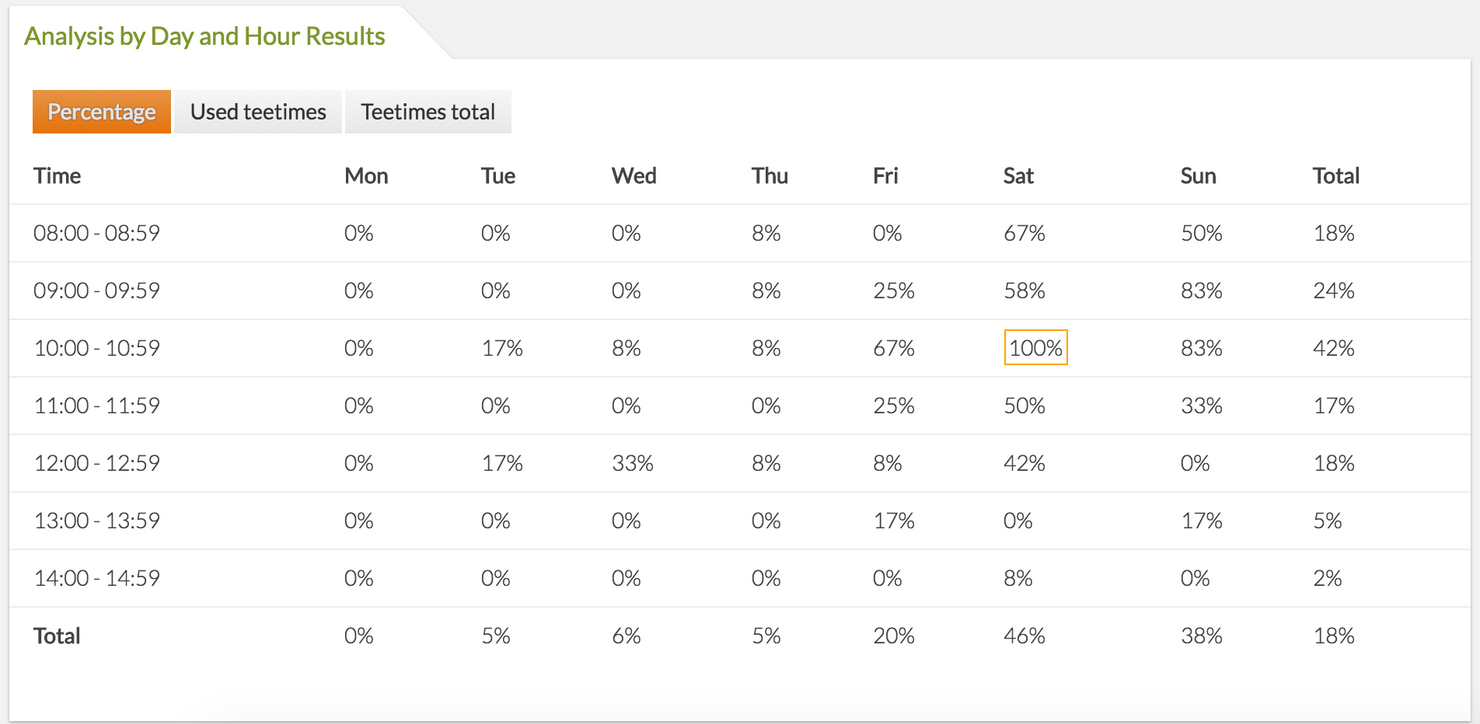
Anyhow, back to utilisation. Ideally, every user of the golf course would book into your technology solution, which can then produce a report on the utilsation of tee times by hour and day. However, this is not always going to be the case, but it is good to produce a report similar to the below even if it does involve some guess work. It is also important to consider the times of year that this report will change.

In summary, this type of utilisation report is very powerful and a great base for considering price. However make sure you consider other relevant factors when creating your pricing strategy such as (but not limited to): Competitors, course condition, customer type, time of year/weather, local events, lead time and booking channel… I could go on. It is also worth noting that this list will vary depending on the golf course, along with the impact of each factor.

Read more

T is for Technology in golf…

Like all technology, golf related systems have come a long way since the early 2000’s where most of it ran from MS-DOS/Windows 95 to now, where the majority is cloud based making it accessible through a variety of web browsers.

Today there is an abundance of technology for all aspects of operating and managing your golf course. Some of the most recent tech development is for managing your golf course, with software using HD ariel images to identify anything from excessive moisture to high turf stress areas. However, I digress and this is not our area of expertise!

In terms of technology used to operate a golf course, we believe there are some key areas to consider:

  • Tee Sheet (inclusive of digital member/visitor booking experience + reporting)

  • Communications (automated & manual email, text comms & database management)

  • Competition & Handicap Management

  • Membership Management

  • Event/Function Management

  • EPOS

  • Website

All of these different areas beg the question should they be ran by one software provider or is integrating two or more providers efficient? Ultimately, this depends on the what the golf course is looking to achieve and how good the integrations are.

Given that our service is all about increasing visitor green fee revenue, we are going to focus on the digital visitor journey, which areas the journey touches, and the questions a golf course should ask itself when looking at technology solutions…

Phase 1 – Website:

A potential visitor lands on your website…

  • Is the experience mobile responsive?

  • Is it easy to find the visitor booking engine on both mobile and desktop?

  • Does the website try to capture any customer data with an offer (or similar) prior to the booking? If so, where does this data go?


Phase 2 – Visitor booking engine/tee sheet:

The potential visitor clicks through to the booking engine…

  • Again, is the booking engine mobile responsive?

  • Does it have the ability to accept voucher codes and present multi-ball pricing?

  • Does the system capture customer data and where does it store this?

  • How does the golfer pay and is the method PCI compliant?

  • Do you have the ability to sell additional items such as a buggy, trolley or food items? If so, does the booking engine take items such as buggies out of stock?

  • Is the booking engine showing live availability from the tee sheet?

  • Can you present a different price to your direct booking engine versus other third parties channels to encourage direct booking?

  • Do you have barter tee times showing on your booking engine?


Phase 3 – Booking engine:

The golfer decides to make a booking…

  • What confirmation does the golfer get?

  • Is the confirmation email branded with your logo/images, and is it automated from within the email communications tool?

  • If the golfer fails to make a booking (for whatever reason), does the system send an automated ‘basket abandonment’ email?


Phase 4 – Golfer arrives onsite:

The golfer arrives at the pro shop…

  • Have all the visitor details been transposed onto the tee sheet?

  • If the booking is more than a 1 ball, how easy is it to capture the other golfer’s data? Note that some systems offer the ability for the customer to electronically add their data via a tablet.

  • Is the information easily transposed on to the till whether it be directly linked or a separate system? If the till is linked does it ‘arrive’ the booking in the tee sheet?

  • If the booking has changed is it easy to edit?


Phase 5 – Follow up:

The golfer has finished playing golf and gone home…

  • What communication does the golfer receive in the next 24 – 48 hours and can this be automated?

  • Does the future communication have the same look and feel as the initial tee time communication so it is easily recognisable?

  • Has the golfers data gone into the visitor database within your communications suite, and how easy is it to communicate with them by text or email moving forward?\

Phase 6 – Analysis and reporting:

The golfer has long left the facility but did the course charge the right price…

  • This comes down to the reporting available, for example can you monitor course utilisation, lead time and revenue per channel?

  • Can you easily export this information and use it to make better decisions about your visitor pricing per channel?

The above only covers a small amount of how a golf course will use its technology, and by no means are the questions exhaustive. Even from this small section it’s easy to see how a ‘straightforward’ visitor booking can touch so many areas of the golf courses’ technology solution. Plus if these areas are not integrated well or within one solution this will create additional work and lead to data/revenue being lost.

When looking at a technology solution make sure you consider each user group such as Administrators (including staff/committee members), Visitors (including online bookings and societies) and Members (including flexible and ‘full’ members).

If you would like some independent advice on your technology solution then please do get in touch with us on [email protected].

#Teesheet #EPOS #Technology

Read more

S is for Secrets of a winning third-party strategy…

  • Oct 21, 2017   4 min read

There is no denying that third-parties are marketing powerhouses. However they can seem at odds with golf courses, but with the right strategy they are a powerful tool for a golf course to use. Third parties historically have provided the best booking experience combined, with the best and most targeted marketing, therefore have dominated the online tee time market.

Within the hotel industry third parties control approximately two-thirds of online bookings, they also have access to around 99% of hotel inventory. In the golf industry third parties do not have access to as much inventory (tee times) and have less control of the online market. Undoubtedly the golf industry is somewhat behind the hotel industry, for example there are still a number of courses that do not allow online bookings but time will change this.

Third parties typically invest significantly more in marketing compared with an independent golf course, and because golfers see this message more often, they can believe a better deal is available by booking through the third party. Some golf courses do offer better pricing through third parties, however it is our opinion that the golfer should always get the best deal when they book direct. Whether this be the best price, the best lead time, no booking fees, value adds, loyalty programs etc – booking direct is best for the golf course, and should always be the best deal for the golfer.

With the right strategy golf courses can increase their share of online bookings, reducing the costs associated with third parties and putting control back into their hands. Third parties play a significant role in this strategy. For starters, 50% of third party bookers in the hotel industry visit the official hotel website before booking. Golf courses can better capture the golfer who visits their website through improved user experience, user-driven design, and an emphasis on making booking as easy as possible.

In the hotel industry the overwhelming majority of travellers (85%) believe price to be the most important factor when deciding where to book— and associate lower prices with third parties. Price certainly has a big influence in the golf industry, however by selling direct, price has a less of an influence as golfers are in less of competitive environment, and are less likely to look at a competitors product. This also highlights how important it is to offer the best price direct.

Technology is key to getting golfers to book direct. For example, if someone abandons a tee time on your website (known as ‘basket abandonment’ in the e-commerce world), does your tee sheet/booking engine have the ability to re-target these users by sending an email encouraging/reminding them to book? Statistics suggest that between 20% – 50% of abandoned purchases can be recovered with the right technology. This is just one example of how technology can help drive direct bookings. To be clear, in order to increase online bookings, golf courses must fully understand what their technology can do, and if it is not fit for purpose, change it. Online bookings will only increase their share of a golf courses revenue stream as time goes on.


Considering the reach and traffic third parties generate daily, golf course operators should strategically use third party channels only during ‘off-peak’ or ‘need’ periods. Perhaps even more importantly, golf courses should track golfers who book through third parties and target them with special direct booking deals.

Adam Anderson, Director of Industry Relations at Expedia, revealed in a recent interview how most hotels and resorts are missing the mark by not leveraging third party tools, meaning they’re losing out on money, far-reaching exposure and even DIRECT bookings. We have provided a synopsis of the interview, and what we believe should be applied to the golf industry:

  • Content on a third party website is key – making sure you have top quality photography and a concise description can increase bookings by 1.9% and 2.1% respectively.

  • Third parties can help increase direct online bookings as web traffic is proven to flow from the venues page on the third party, directly to their own website. Just make sure your website is mobile friendly, looks great and has the ability to take bookings online!

  • Manage your distribution strategy by using the technologies and tools to attract the right bookings, at the right time. For example you could use third parties such as Golfbreaks.com to drive long lead (3 – 6 months) group bookings combined with society/group offers, a direct booking engine to drive bookings from 90 – 3 days, then use third-party tee time distributors to late fill the 48 hour and in tee times.

  • Reviews – although the hotel industry is much further ahead (tripadvisor) compared with the golf industry the principal is still the same. Good reviews mean more bookings at a higher price, so be sure to monitor and respond on review websites.

  • Use the data third parties have such as average rate, lead time etc, to help set your overall online green fee strategy.

  • Ranking on a third party website is somewhat of a “secret sauce”. However, it goes without saying that good rates and good availability bump you up (in the search results).

Feel free to get in touch if you would like to talk about your third party strategy – [email protected].

#ThirdParties #OnlineTeeTimes #Teeofftimescouk #GolfNow

Read more

R is for Revenue Management in golf…

A golf course has a fixed capacity, perishable product, high fixed costs and low variable costs, the green fees can be priced differently, demand evolves, the green fees can be sold in advance and the market can be segmented. These factors make a golf course ideal for applying revenue management.

Revenue management helps to predict and influence consumer demand to optimise inventory and price in order to maximise revenue/profit growth. Revenue management started with the airline industry, today it is applied in many industries including golf!

Revenue management is at the core of what we do at The Revenue Club. With that in mind we have added our top tips on how to create a successful revenue management strategy at your golf course (as an alternate to using our services!):

  • Get your distribution channels right: A number of factors are important which include ease of channel management; their potential; the cost involved; marketing opportunity the channel provides; and not least, the technology it uses and its compatibility with your own tee sheet.

  • Offer book direct incentives: Booking through external partners such as teetimes.co.uk is important, but direct bookings are the most desirable method of reservation. A golf course can encourage direct bookings by offering value-added incentives. These can include anything, from buggies in the price to add value, price reductions, better lead times and so forth. The goal is to divert golfers away from using third parties, where they are more likely to choose a competitor.

  • Maintain organised records of key data: Good data is key to a successful revenue manamgent strategy, and knowing your REVPATT number for the same month last year will help you make smarter decisitons about tee time pricing.

  • Always keep up with consumer trends: It is important to be aware of what is happening in the wider market. For example, of late booking lead times through third parties have been reducing and shifting to Friday – Sunday playing days.

  • Prioritise website and mobile experience: Quite simply, too many golf course websites are out of date or neglected. Considering the number of golfers booking online is increasing, it is paramount to have an updated, optimised website for computer, mobile and tablet – especially your visitor booking engine. A professional website also requires periodic updates, taking into account technology updates, changing customer behaviour, design trends and security. An optimised website assists your search results. But you can also use it as a foundation for online marketing tactics including advertising via Google and social media as well as organic growth.

  • Technology: Does your tee sheet allow you to select a different lead time for each online channel? Does it allow you to easily add multi-ball pricing? Does it provide you with the reports you need to analyse the data for revenue management? Does it have a mobile responsive booking engine? If not, it will be a lot of work to implement a successful revenue management strategy.

  • Internal communication: It’s important that all team members at the golf course understand the Revenue Strategy and what the GM/Secretary is looking to achieve this month and this year. It is especially important for your golf operations staff to understand why the price of a green fee might change, and how to handle this if a customer queries it. For example, if you are looking to drive volume it is particularly important to push up sells such as buggies, F&B etc.

  • Online reviews: Put simply the better your online reviews, the easier it is to increase rate

  • Workload & a quiet office: analysing data and editing rates accordingly requires a quiet uninterrupted space. From personal experience this is very difficult to achieve in a golf course environment, with constant interruptions from members, staff or the telephone! If you are looking to analyse data perhaps work from home for the morning or similar! Lack of time is often the reason for employing the services of The Revenue Club.

If you would like a meeting at your golf course about what impact revenue management could have, then please do get in touch via the contact form on our website and we will arrange a time to meet.

Read more

Q is for Questions…

This week’s blog covers three of the questions we get asked most regularly by golf course operators…


1. What does The Revenue Club actually do, are you another 3rd party tee time market place website?

We are not another 3rd Party website, but we do help golf courses to increase their net revenue through green fees booked online. Our service is about ensuring our partner golf course’s “online reach” is maximised, and applying “revenue management” techniques to their tee sheet much like hotels do with their bedrooms.

We measure and manage the different routes a golf course has to sell their green fees online, ensuring that our partners are selling through the most profitable channel at the best rate possible. Practically speaking we do a twice-weekly ‘sweep’ of our partner’s tee sheets for the coming 1-5 days, and adjust their pricing to ensure all pockets of availability are maximised, if it’s busy the price might jump up, if it’s unusually quiet then perhaps we publish a special offer, as part of this sweep we also consider how other factors can affect price such as weather. Further to this we monitor the costs that are associated with online green fee booking, which includes commissions, net rates and inventory costs                              such as barter tee times. We wrap all this activity up into a comprehensive monthly report which helps us track progress.

We are also Google Adwords certified so can help golf courses manage their online paid advertising campaigns.


2. How can we increase the average green fee rate?

This is a complex question which should not necessarily be met with the simplistic answer of “increase or hold rate” as a number of factors can affect the average rate. For example, booking channel will affect the net green fee rate a course achieves, third parties will generally take a 20% commission in golf instantly reducing the net average rate overall. It is also important to consider if the green fee is packaged up as part of a corporate/society/residential package, as the allocation for green fees is often lower than the ‘normal’ rate.

Time of play and day of week is a big factor when looking at average rate, for example a Sunday morning tee time is worth considerably more than a Monday afternoon tee time, so if a golf club were to generate 90% of its business through week day afternoon green fees (other than a Friday) the average rate would be considerably less than if they sold 90% of their golf on a weekend morning. It’s also worth thinking about whether you are interested in the average rate per person or the average rate per booking, with the latter often leading to the former reducing!

Some course operators and perhaps members committees put a lot of importance on “the average rate” as it can be regarded as an indicator of status. At TRC we generally take the approach that this more historic view is relevant to the average rate of “the members times” but less relevant to the quiet/off peak times. Somewhat ironically this can often lead to the prime/members times going unsold due to holding the rate too high or being blocked off completely from sale. The net result can be that the club increases the volume of green fees but achieves a lower average rate, as the only tee times being sold are the most under-utilised and generally cheapest. Online review sites such as golfshake.com are now a better indicator of course quality.

The final point I will mention (although I could go on!), is the general rule that direct bookings through your own website will achieve a higher average rate than those which come through a 3rd party website. With that in mind it’s an easy win to ensure you offer all your best times to visitors firstly through your own website (if at all possible).

Although average green fee rate is a very important factor at any golf course, we encourage our partner courses to consider REVPATT (revenue per available tee time) and TREVPATT (total revenue per available tee time) which also considers on spend such as buggies etc.

3. How much does becoming a ‘member’ of The Revenue Club cost?

We work on a monthly subscription of £200 + VAT per course per month. We offer interested golf courses a no-strings attached 1 month trial, and if we provide an ROI then we hope that the golf course will continue to work with us and pay us for the work completed. Our service is designed to help golf courses add a specialised team member to their operation for a few hours each month, unlocking potential to generate more revenue, whilst working in line with the courses’ own priorities, much like a revenue manager would for a hotel.

Read more

P is for Profitable pay & play green fees

The Revenue Club are now working with over 40 golf courses across the UK, and have seen a number of courses exceeding 50% of their total pay and play business booking online, and the share is only heading in one direction! With so many pay and play golfers making the shift to book online, it is increasingly important to consider the costs associated with the online booking process.

In order to make these bookings more profitable, a golf course must consider the costs that are directly related to selling green fees online. Some of key costs include:

  • Website

  • Visitor booking engine and your electronic tee sheet

  • Third party commissions/booking fees and barter times

  • Your time in managing online green fees/systems

  • Payment processors

  • Paid digital advertising

Historically, golf courses have relied heavily on third parties to drive much of their online green fee revenue. A lot of courses will sell tee times online through a third party, but not through their own website (which I still cannot understand!). This can make selling green fees online less profitable as the golf course will either give away a percentage of the green fee (usually 20%) or bartered tee times along with a booking fee per golfer. That said third parties are absolutely necessary and can be a very powerful tool for selling green fees, but to maximise profit must be managed correctly. A golf course should know and manage its channel mix.

Whilst on the subject of third parties, it is important to discuss the impact barter tee times can have on a tee sheet’s pay and play profitability. Some third parties who use barter as a method of payment work on a ratio basis (which in a sense is much like commission as the cost is known), and others work on a 1, 2 or more tee time per day basis depending on the services you receive from them. Whichever method is used a golf course must be aware of the opportunity cost created by barter. The best way to do this is to calculate the average rate for the paid rounds in the same day and day part as each barter round. Generally, the barter times will be sold at a price lower than that of the courses own inventory and receive additional marketing, so it can be argued that these barter times help to stimulate demand through price and the extra marketing. The bottom line is that a golf course must be aware of how much they are paying (the opportunity cost) for the technology/services they are receiving through bartered tee times, after all, you wouldn’t pay an invoice without knowing how much the invoice was for!

Creating more profitable green fees is also about better utilising the golf course, which is influenced by how and when you market visitor golf, along with the price you advertise. For example, a golf course can encourage off peak bookings and increase yield during peak times by using dynamic pricing and increase group size/revenue per tee time through incremental prices. Using dynamic pricing as part of a wider revenue management strategy is very much part of what we do at The Revenue Club, and we encourage any golf course to try flexing their rate to maximise yield and stimulate demand

When pricing green fees it is necessary to consider the on spend which a golfer will deliver. Items such as buggies, trolleys and food & beverage are all highly profitable income streams for a golf course – an increase in occupancy will in most cases lead to an increase in on spend, however make sure you keep an eye on the KPI’s of average revenue per round and revenue per available round.

Read more

We are here to assist